
Customer Comments Are Revenue Signals: Why Modern Sales Teams Are Automating Quote Engagement
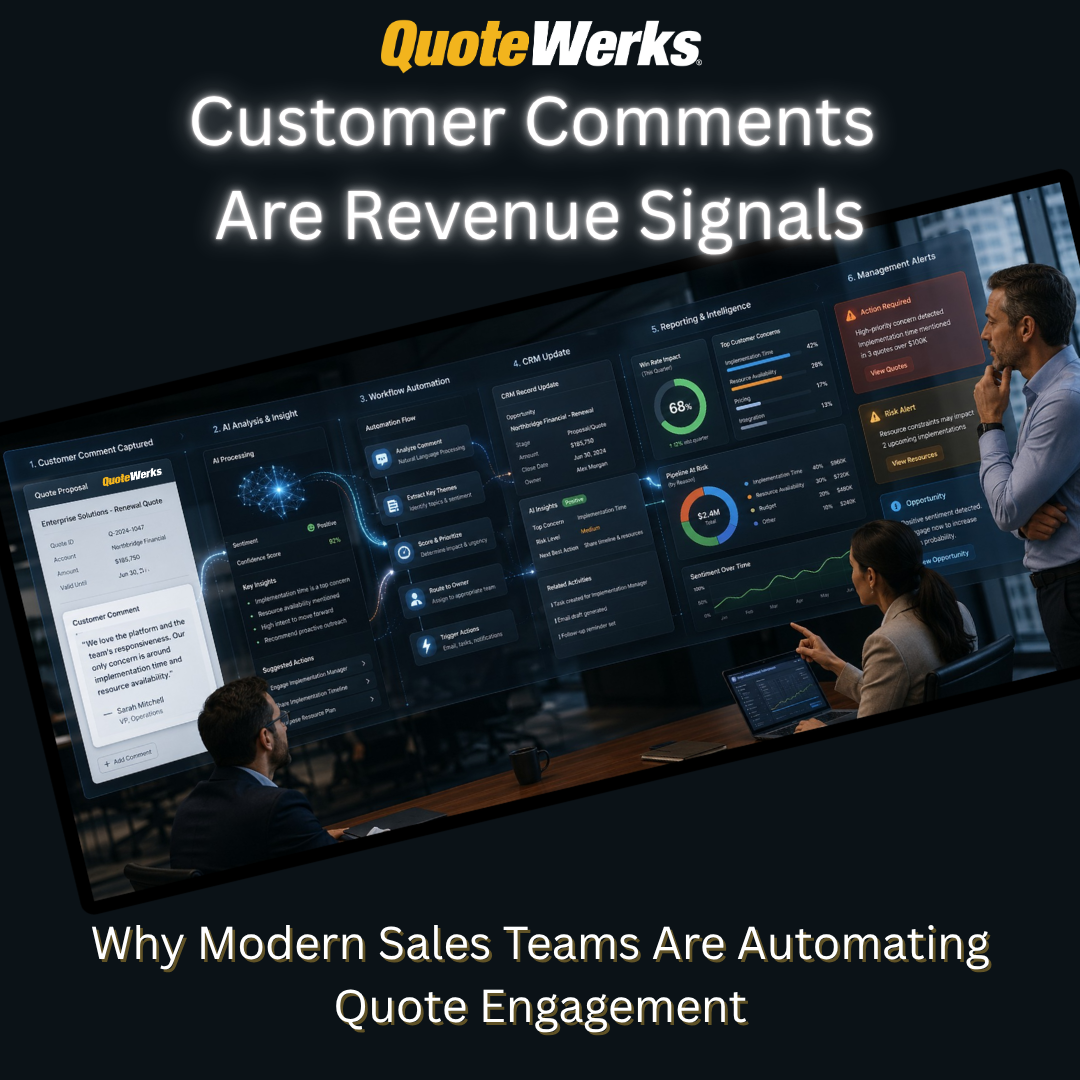
Most sales teams spend significant time improving how they create, deliver, and manage quotes.
Faster quote generation. Better proposal design. Streamlined approvals. Electronic signatures.
All of these improvements matter.
But many organizations overlook a much larger opportunity hidden within the quoting process itself.
The most valuable information often isn't the quote.
It's what the customer says and does after receiving it.
A prospect asks a question.
A stakeholder leaves a comment.
A buyer raises a pricing concern.
A procurement team requests changes.
A decision maker mentions another vendor they're evaluating.
These interactions contain valuable business intelligence, yet many organizations still rely on salespeople to manually notice, document, communicate, and act on the information.
As revenue operations become increasingly data-driven, leading organizations are beginning to view customer engagement differently.
Instead of treating quote interactions as passive information, they are treating them as operational triggers that can automatically launch workflows across the business.
The Hidden Intelligence Inside the Quoting Process
Most organizations track basic quote milestones:
- Quote sent
- Quote viewed
- Quote approved
- Quote accepted
- Payment received
These metrics provide visibility into the sales process, but they only tell part of the story.
The more interesting information often lives between those milestones.
Consider the following customer comments:
"We're also evaluating another provider."
"The other proposal came in less expensive."
"Our procurement team needs different payment terms."
"We may need to delay the project until next quarter."
"Can this be split into phases?"
Each statement reveals something important.
A competitor may be involved.
Pricing pressure may be increasing.
The deal timeline may be changing.
The customer's buying process may be more complex than originally expected.
Historically, this type of information often gets trapped inside:
- Email conversations
- CRM notes
- Proposal comments
- Internal chat messages
- Salesperson memory
Some salespeople document it thoroughly.
Others do not.
Some managers gain visibility immediately.
Others discover it weeks later during a pipeline review.
This inconsistency creates risk.
Not because the information doesn't exist, but because organizations lack a consistent process for capturing and acting on it.
The Rise of Event-Driven Revenue Operations
A growing number of organizations are adopting what could be described as event-driven revenue operations.
The concept is simple.
When something important happens during the sales process, the event automatically triggers the next action.
Rather than relying on manual follow-up, technology helps ensure the right people, systems, and workflows respond immediately.
In an event-driven model:
- Customer engagement becomes operational data.
- Sales activities become workflow triggers.
- Business intelligence is captured automatically.
- Processes become more consistent and scalable.
Instead of a customer comment sitting unnoticed inside a proposal, it becomes an event that can launch actions across the revenue technology stack.
A Real-World Example: A Security Integration Company in Chicago
Imagine a security integration company based in Chicago.
The company specializes in:
- Access control systems
- Video surveillance solutions
- Alarm monitoring services
- Security infrastructure projects
- Ongoing service agreements
Their sales team sends a proposal to a prospective customer.
While reviewing the proposal, the customer leaves the following comment:
"We're also reviewing proposals from a couple of other security companies before making a final decision."
That single comment contains meaningful information.
It indicates:
- The opportunity is competitive.
- The prospect is still actively evaluating options.
- The sales team may need stronger differentiation.
- Management may want visibility into the deal.
- The CRM should reflect competitive pressure.
- Future win/loss reporting could benefit from this context.
In many organizations, the next steps depend entirely on whether the salesperson notices the comment and manually updates multiple systems.
Sometimes that happens.
Sometimes it doesn't.
Now imagine a different approach.
Instead of relying on manual action, the customer comment automatically triggers a series of workflows.
The opportunity is tagged as competitive.
The account executive receives relevant sales guidance.
Management receives an alert.
The CRM is updated.
Competitive intelligence reporting is refreshed.
All within seconds.
This is the power of treating customer engagement as an operational event rather than simply another note in the sales process.
Why Competitive Intelligence Is Often Incomplete
Most companies want better competitive intelligence.
They want to know:
- Which competitors appear most often.
- Which competitors win deals.
- Which objections occur most frequently.
- Which sales strategies are most effective.
The challenge is that much of this information is gathered manually.
Salespeople are busy.
Data entry is inconsistent.
Details are forgotten.
As a result, organizations often make strategic decisions based on incomplete information.
By automatically capturing signals from customer interactions, businesses can improve both the quality and consistency of competitive intelligence reporting.
Instead of depending on memory, they can rely on actual customer engagement data.
The Next Evolution: Combining AI with Customer Engagement
The next stage of revenue operations becomes even more powerful when artificial intelligence is introduced.
Consider a customer comment such as:
"The other company's proposal is less expensive."
An AI-powered workflow could automatically classify:
- Competitor involved
- Pricing objection
- Elevated deal risk
- Potential discount request
The system could then:
- Create a CRM task
- Recommend a response strategy
- Deliver relevant sales enablement content
- Notify management if the opportunity exceeds a defined value
- Update reporting dashboards
Similarly, a comment such as:
"We may not move forward until next quarter."
could automatically trigger:
- Forecast updates
- Opportunity stage review
- Follow-up scheduling
- Management visibility
The result is a more responsive and data-driven sales organization.
How QuoteWerks Helps Turn Quote Activity Into Action
This is where QuoteWerks Webhooks become particularly valuable.
Many organizations already use QuoteWerks to create professional quotes and proposals.
When combined with QuoteValet and webhook automation, QuoteWerks can also help transform customer engagement into automated business processes.
As customers interact with quotes through QuoteValet, events can be captured and sent to other systems in real time.
QuoteWerks Webhooks can connect quote activity with:
- CRM platforms
- PSA systems
- Slack
- Microsoft Teams
- Google Chat
- Zapier
- Make
- n8n
- Microsoft Power Automate
- Custom applications
- AI-powered workflows
Instead of requiring salespeople to manually communicate every important customer interaction, QuoteWerks can help automate the flow of information throughout the organization.
For the Chicago security company example, a customer comment could trigger a webhook event that initiates an automated workflow.
That workflow might:
- Update the CRM.
- Notify sales leadership.
- Create follow-up tasks.
- Trigger AI classification.
- Generate reporting updates.
- Deliver sales guidance.
The specific workflow depends on the organization's goals, systems, and processes.
The important point is that quote engagement becomes actionable.
Practical Revenue Automation Use Cases
Competitive intelligence is only one example.
The same event-driven approach can support many other business processes.
High-Value Opportunity Alerts
Notify executives when strategic opportunities are viewed, commented on, approved, or accepted.
Pricing Objection Workflows
Automatically route pricing concerns to the appropriate sales leaders or deal desk teams.
Customer Success Handoffs
Launch onboarding and implementation processes immediately after a quote is accepted.
Procurement Automation
Trigger purchasing, fulfillment, or project creation workflows based on customer actions.
Renewal Risk Detection
Identify customer concerns before renewal deadlines are reached.
Executive Notifications
Provide leadership visibility into important opportunities without requiring manual reporting.
Compliance and Approval Workflows
Automatically enforce internal review processes when predefined conditions are met.
From Quote Creation to Revenue Automation
For years, quoting software has been evaluated primarily on its ability to create quotes faster.
That remains important.
However, modern revenue teams are increasingly looking beyond document generation.
They want systems that connect people, processes, and technology.
They want automation that reduces manual work.
They want better visibility into customer behavior.
They want actionable intelligence instead of disconnected data.
Most importantly, they want sales activity to drive business outcomes automatically.
The organizations that embrace event-driven revenue operations are creating more consistent processes, better reporting, faster response times, and stronger alignment across sales, operations, management, and customer success.
The Bigger Opportunity
The Chicago security company example isn't really about competitor monitoring.
It's about recognizing that every customer interaction contains valuable business intelligence.
A comment.
A question.
A concern.
An approval.
A signature.
A payment.
Each represents an opportunity to automate the next step.
When quote activity becomes a trigger for action, organizations gain far more than visibility into the sales process.
They create a foundation for scalable revenue operations.
And that may ultimately be one of the most valuable benefits of modern CPQ and quoting software.
Frequently Asked QuestionsWhat is event-driven revenue operations?
Event-driven revenue operations is the practice of using customer and sales activities as triggers for automated business processes. Examples include quote views, approvals, customer comments, signatures, and payment events.
What are sales webhooks?
Sales webhooks automatically send information to another application when a specific event occurs. They allow organizations to connect sales activities with CRM systems, collaboration tools, automation platforms, and custom workflows.
How can customer comments improve competitive intelligence?
Customer comments often reveal competitor involvement, pricing concerns, procurement requirements, and other factors that influence buying decisions. Automatically capturing this information improves reporting and sales execution.
Do QuoteWerks Webhooks require a developer?
Not necessarily. Many organizations use QuoteWerks Webhooks with low-code and no-code automation platforms such as Zapier, Make, and Microsoft Power Automate.
What types of workflows can QuoteWerks Webhooks automate?
Common examples include CRM updates, executive notifications, sales alerts, customer success handoffs, procurement processes, approval workflows, competitive intelligence tracking, and AI-powered classification workflows.